

Medication Allergy ID Bracelet Explained for Safer Emergencies
Posted by Mack Johnson on May 28th 2026
Medication Allergy ID Bracelet Explained for Safer Emergencies

Many people assume medical alert jewelry is only for the elderly or those with heart conditions. That assumption can be genuinely dangerous. A medication allergy ID bracelet, the industry term is medical alert ID bracelet, is one of the most critical safety tools available for anyone with a serious drug allergy. Whether you are a parent of a child with a penicillin allergy or an adult managing multiple medication sensitivities, this guide covers what these bracelets are, how to use them correctly, who needs one most, and why the details you engrave can make a life-or-death difference in an emergency.
Table of Contents
- Key Takeaways
- Medication allergy ID bracelet explained: what it is and how it works
- Who should wear a medication allergy ID bracelet
- How to use your allergy ID bracelet for maximum safety
- Complementary safety tools to use alongside your bracelet
- My honest take on allergy ID bracelets
- Get your personalized medical alert bracelet from Divotiusa
- FAQ
Key Takeaways
| Point | Details |
|---|---|
| Bracelets speak when you can’t | A medical alert ID communicates your drug allergies instantly when you are unconscious or unable to speak. |
| Dominant wrist placement matters | Wearing your bracelet on your dominant wrist increases detection by first responders who check for vital signs there. |
| Short engraving beats long text | Standardized abbreviations like “NO PCN” allow EMTs to act faster than full sentences ever could. |
| Kids need them too | Children who cannot communicate allergies during emergencies benefit most from a visible, well-engraved ID bracelet. |
| Tech supplements, not replaces | QR codes and phone Medical IDs are useful backups, but physical engraved jewelry remains the most reliable in a crisis. |
Medication allergy ID bracelet explained: what it is and how it works
A medication allergy ID bracelet is a piece of wearable jewelry, most commonly worn on the wrist, that is engraved with critical medical information. Specifically, it alerts emergency responders to drugs or substances that could harm or kill the wearer if administered. Think of it as a silent spokesperson. When you cannot speak for yourself, it speaks for you.
These bracelets come in several formats:
- Metal engraved bracelets: Stainless steel, sterling silver, or titanium options with permanently engraved text. These are the most durable and readable in a crisis. You can explore safe metal type options to find the right material for your lifestyle.
- Silicone bands: Lightweight and budget-friendly, popular for children and active wearers. Durability varies by brand.
- Medical alert necklaces: A solid alternative for wearers who prefer not to wear wrist jewelry, though slightly less visible to first responders.
- QR code and NFC-enabled bracelets: These include a scannable code or chip that links to a full digital health profile.
The digital additions deserve a closer look. QR codes and NFC chips offer the benefit of storing detailed profiles, including medication lists, doctor contacts, and allergy history. The catch is that they require a working phone and network connection. During a power outage or a remote emergency, that technology may be unavailable. Physical engraving remains non-negotiable.
First responders are trained to check a patient’s wrists almost immediately on arrival. They look for the universally recognized medical alert symbol, a six-pointed star known as the Star of Life, combined with readable engraving. A clean, clearly engraved bracelet allows a paramedic to rule out certain treatments within seconds, which genuinely saves lives.
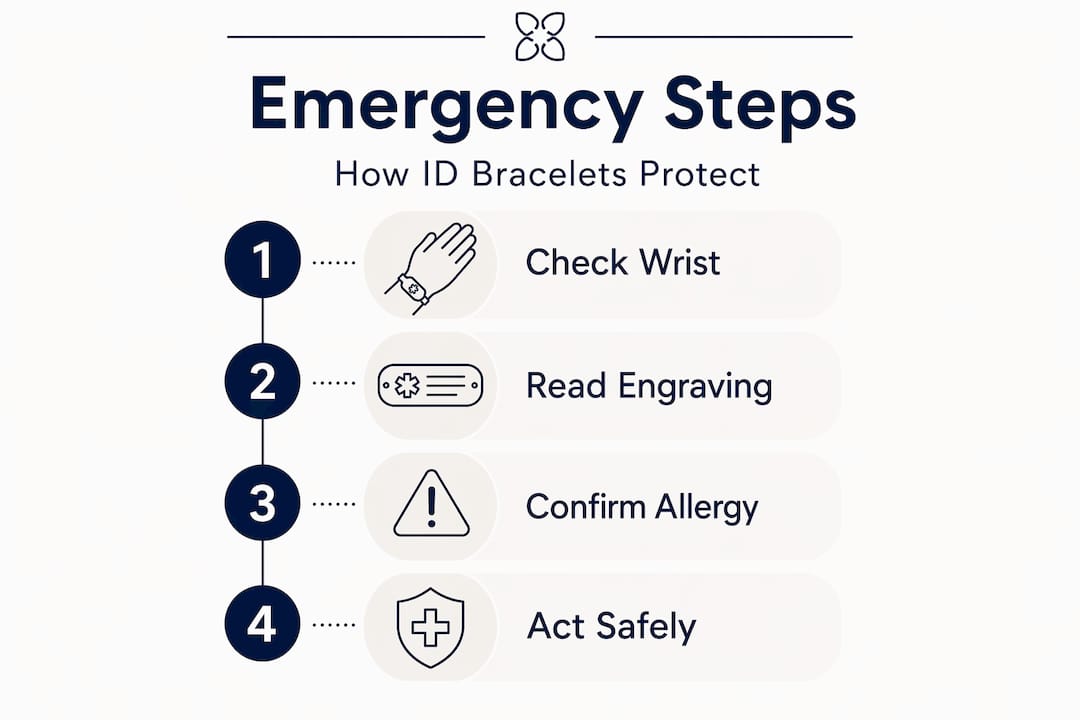
Pro Tip: If your bracelet includes a QR code, test the scan yourself periodically to confirm the linked profile is accurate and accessible.
Who should wear a medication allergy ID bracelet
The short answer is anyone with a drug allergy serious enough to cause a life-threatening reaction. But the reality is more nuanced.
Adults with severe medication allergies are the most obvious group. If you are allergic to penicillin, sulfa drugs, NSAIDs, or contrast dyes used in medical imaging, you are at real risk during any emergency where you may be unconscious or unable to communicate. Administering the wrong drug to someone with a known allergy can trigger anaphylaxis, a rapid and potentially fatal reaction.
Children are arguably the group with the most urgent need. A child in an accident or severe allergic reaction may be too young, too frightened, or too physically compromised to explain their allergy. Medical ID jewelry also helps children feel more comfortable discussing their allergy in school settings, which builds important self-advocacy habits over time.
There are also less obvious groups who benefit:
- Adults managing polypharmacy (taking multiple medications where interactions matter)
- Individuals with latex allergies, which affect surgical and emergency care
- People with contrast dye allergies who may undergo emergency imaging
- Those with a history of anaphylaxis, even if previous reactions were to food rather than medication
“Over 95% of EMTs actively look for medical alert jewelry during crises, according to allergy professional associations. Without a visible ID, your allergy history is invisible to the people trying to save your life.”
That statistic puts the stakes in plain terms. If a paramedic administers a medication you are allergic to because there was no visible alert, the consequences could be severe. The bracelet closes that communication gap.
How to use your allergy ID bracelet for maximum safety
Owning a medical alert bracelet is not enough. How you engrave it, where you wear it, and how often you update it determines whether it actually protects you.

Engraving best practices
Follow this priority order when deciding what to put on your bracelet:
- Your primary allergy with a standardized abbreviation. “NO PCN” means no penicillin. “NO SULFA” covers sulfonamides. Standardized abbreviations reduce treatment delays because EMTs recognize them instantly without having to decode full drug names.
- Any secondary life-threatening allergies. Space permitting, list additional allergens in the same abbreviated format.
- Your primary condition, if relevant. For example, “ANAPHYLAXIS RISK” communicates the severity to the responder.
- An ICE (In Case of Emergency) contact number. Including a labeled ICE contact on your ID improves how quickly EMS can reach your family or doctor.
- Your name. Optional but helpful in multi-patient emergencies.
Placement and visibility
Dominant wrist placement correlates directly with higher first-responder detection rates. Paramedics check the dominant wrist when taking a pulse, which is one of the first things they do on arrival. Wearing your bracelet on that wrist is a practical choice, not just a preference.
Compare the two most common wearing options:
| Option | Visibility to EMTs | Comfort | Best for |
|---|---|---|---|
| Dominant wrist bracelet | High (checked for pulse) | Good for most wearers | Adults and children |
| Non-dominant wrist bracelet | Moderate | Preferred by some active users | Active sports wearers |
| Necklace | Lower in emergencies | Comfortable daily wear | Those who cannot wear wrist jewelry |
Maintenance and updates
A critical but overlooked detail is keeping your engraving current. Outdated medical ID information can be as dangerous as no ID at all. Schedule a review of your bracelet information annually, ideally aligned with your yearly physical exam. If your allergy list changes or you are prescribed new medications, update your ID promptly.
Pro Tip: For parents choosing a bracelet for a child, opt for an adjustable design that can grow with them and fits snugly enough to stay visible without being uncomfortable.
Complementary safety tools to use alongside your bracelet
A medication allergy ID bracelet works best as part of a broader safety system, not as a standalone solution.
Your smartphone Medical ID is one of the most underused tools available. Apple’s Medical ID can be accessed directly from the iPhone lock screen without a passcode, and it automatically shares your health information during emergency calls to 911. You can add your allergies, current medications, blood type, and emergency contacts through the Health app. Android users have similar functionality through the Emergency Information section in device settings.
Beyond your phone, consider these complementary strategies:
- Carry an epinephrine auto-injector if your doctor has prescribed one. A bracelet identifies your allergy; the epinephrine treats the reaction.
- Keep a printed allergy card in your wallet with your full allergy history and prescribing doctor’s contact information.
- Communicate your allergies proactively with schools, workplaces, caregivers, and airlines. Do not rely on emergency identification alone.
- Register with your pharmacy so any new prescription is automatically screened against your allergy list.
- Ask about insurance coverage. Some insurance plans reimburse the cost of medical alert bracelets when accompanied by a physician’s prescription documenting medical necessity. It is worth asking.
The most prepared individuals combine physical jewelry with a digital backup and clear communication with the people around them. Hybrid ID systems that pair engraved info with a QR code profile address both the space limitations of engraving and the update frequency challenge, giving you a thorough safety net.
Pro Tip: When traveling by air, inform the airline’s special assistance team of your allergy before the flight. Many airlines can flag medical alerts in your booking record.
My honest take on allergy ID bracelets
I have spent years reading about and speaking with people in the medical alert space, and one pattern keeps repeating. People rarely get a medication allergy ID bracelet before a scare. They get one after. After a trip to the ER, after a close call with a mislabeled medication, after watching someone they love struggle to communicate during a crisis.
That delay is the part that genuinely concerns me. The bracelet is not complicated. It is not expensive. And yet so many people treat it as optional, something they will “get around to eventually.” The uncomfortable truth is that emergencies do not give you advance notice.
I have also seen the opposite problem. Someone has a bracelet but the engraving is ten years old, reflecting a medication allergy that has since been confirmed as a misdiagnosis, or missing a new allergy added after a recent reaction. An outdated bracelet can misdirect care just as easily as no bracelet at all.
My honest advice to parents especially: do not just buy the bracelet. Talk to your child about it. Make wearing it a habit, not a chore. Work with their school nurse and teachers to explain what it means. Children who understand why they wear their ID are far more likely to keep it on.
The tech additions are exciting and genuinely useful. But I would never recommend relying on a QR code as your primary safety layer. Physical engraving is always on, always visible, and never needs a Wi-Fi signal.
— Mack
Get your personalized medical alert bracelet from Divotiusa
You have the knowledge. Now it is time to act on it.
Divotiusa specializes in custom engraved medical alert jewelry designed to be both reliable and genuinely wearable. Their bracelets are built for people who want critical allergy information displayed clearly without sacrificing comfort or style. Whether you are ordering for yourself or for a child, Divotiusa offers a wide selection of adjustable styles, durable metals, and precise deep engraving that stays legible over years of daily wear. You can explore engraved bracelet styles to find a design that fits your life. Every bracelet can be customized with the exact abbreviations and emergency contacts that matter most to your safety. Do not wait for a close call to take this step. Protecting yourself or your child starts with a bracelet you will actually wear every day.
FAQ
What information should I engrave on a medication allergy bracelet?
Prioritize your most serious drug allergy using a standardized abbreviation (such as “NO PCN” for penicillin), followed by any secondary allergies and an ICE contact number. Keep the engraving short and clear so EMTs can read it within seconds.
Who needs a medication ID bracelet the most?
Anyone with a life-threatening drug allergy, particularly those at risk for anaphylaxis, benefits most. Children with severe allergies are especially high-priority since they may be unable to communicate their allergy during an emergency.
Can I rely on my phone’s Medical ID instead of a bracelet?
Your phone’s Medical ID is a valuable backup, but physical jewelry is more reliable in emergencies. Phones can be lost, locked, or out of battery, while an engraved bracelet is always accessible and requires no technology to read.
How often should I update my allergy ID bracelet?
Review your bracelet information at least once a year, ideally during your annual physical exam. Update it immediately any time your allergy list changes or new medications are added to your health history.
Are medication allergy ID bracelets covered by insurance?
Coverage varies by insurer. Some plans reimburse the cost when a physician provides a prescription documenting medical necessity. Contact your insurance provider and ask your doctor about a written recommendation to improve your chances of reimbursement.
Recommended
- What Is an Adjustable Medical Bracelet? Your Safety Guide - Divoti Inc.
- How to Select Medical Alert Metal Type Safely - Divoti Inc.
- Why Custom Engraved Medical IDs Matter for Safety - Divoti Inc.
- Engraved Medical Bracelet Styles That Work for You - Divoti Inc.
Shop related Divoti medical IDs: browse our allergy and asthma medical alert IDs with free custom engraving. Most styles are HSA/FSA eligible.