

What Is the Medical Identification Standard? A Safety Guide
Posted by Mack Johnson on May 26th 2026

If you’ve ever searched for “what is medical identification standard,” you’ve probably noticed the results pull in two very different directions. Some explain hospital protocols and patient wristbands. Others talk about personal medical alert bracelets. That’s not a coincidence. The term covers genuinely separate systems, and understanding the difference could matter a great deal during a real emergency. Whether you manage a chronic condition, care for a child with severe allergies, or support an aging parent, knowing how medical ID standards work gives you a real advantage when it counts most.
Table of Contents
- Key Takeaways
- What is medical identification standard: the two-system reality
- Personal medical ID standards and everyday practices
- Comparing types of medical identification
- How to implement personal medical ID standards effectively
- My take on why most people get this wrong
- Find the right medical ID for your needs
- FAQ
Key Takeaways
| Point | Details |
|---|---|
| No single universal standard | Medical ID standards exist separately for hospital settings and personal use, covering different goals. |
| Healthcare uses formal protocols | NHS identity band and AIDC barcode standards reduce patient misidentification in clinical settings. |
| Personal IDs follow usability guidelines | Engraved bracelets and cards work best when information is visible, clear, and instantly readable by responders. |
| HIPAA governs data privacy | De-identification standards protect health data but do not define what individuals should wear as medical IDs. |
| Customization improves safety | Selecting durable, hypoallergenic materials and keeping information current maximizes your ID’s effectiveness. |
What is medical identification standard: the two-system reality
Most people assume there is one official rulebook defining what a medical ID must look like, what it must say, and who must wear one. There isn’t. The phrase covers two distinct systems that rarely interact.
The first is the clinical, institution-based system. Hospitals, healthcare networks, and government agencies use formal protocols to identify patients and protect health data. The second is the personal safety system, used by individuals in everyday life to communicate critical health information to emergency responders. These systems have different goals, different audiences, and different standards.
Understanding this distinction prevents a common mistake: assuming that because hospitals use standardized wristbands, there must be an equally rigid rule about the bracelet you wear to the grocery store. There isn’t. But that doesn’t mean personal medical IDs are unregulated free-for-alls. There are well-established best practices that carry real weight in emergencies.
Formal healthcare identification standards
On the clinical side, the standards are specific and well-documented. NHS England’s patient ID standard requires that identity bands worn in hospitals contain clear, unambiguous patient information using four core identifiers. The goal is reducing misidentification, which remains one of the most preventable causes of medical error.
Beyond the printed label, the NHS also defines barcode encoding rules through its Automatic Identification and Data Capture (AIDC) standard. This covers GS1 DataMatrix barcodes, including how patient identifiers are encoded, verified, and printed on identity bands. It isn’t enough for a barcode to be present. It must be produced and verified according to specification to be trusted in a clinical workflow.
In the United States, HIPAA’s de-identification guidance sets the standard for how protected health information can be stripped of identifying details before it is shared or published. Two approved methods exist: Expert Determination, where a statistician certifies re-identification risk is very low, and Safe Harbor, which removes 18 specific identifiers. Neither method is as simple as deleting a name from a spreadsheet.
Here is a summary of key formal standards in healthcare:
| Standard | Issuing Body | Primary Purpose |
|---|---|---|
| Patient Identifiers for Identity Bands | NHS England | Prevent patient misidentification in hospitals |
| AIDC for Patient Identification | NHS England | Standardize barcode encoding on ID bands |
| HIPAA De-identification | U.S. Department of HHS | Protect privacy of health data shared externally |
| Health IT Interoperability Standards | ONC (U.S.) | Support patient identity across health systems |
Pro Tip: If you are a healthcare administrator reviewing compliance, note that HIPAA de-identification requires documented evidence of the method used. Simply removing fields is not sufficient.
Personal medical ID standards and everyday practices
Now for the system that affects you directly. Personal medical identification covers anything worn or carried by an individual to communicate health information to a first responder or bystander during an emergency. Think engraved bracelets, medical ID necklaces, wallet cards, and increasingly, QR code tags.

There is no federal mandate requiring you to wear a medical ID. But the importance of medical identification becomes clear fast when you consider the alternative. A person who is unconscious and allergic to penicillin cannot speak for themselves. Their medical ID does it for them.
The standard practices for personal medical IDs are built around one core principle: visibility and clarity for responders under real-world stress. Responders at an accident scene have seconds, not minutes, to assess a patient. They are trained to check the wrist first. An ID that is buried under clothing, written in small font, or laminated in a way that reflects light is less effective than one that is immediately legible.
What information should your medical ID include?
The generally accepted standard for personal medical IDs includes the following:
- Full name (first and last)
- Primary medical condition (e.g., Type 1 Diabetes, Epilepsy, Severe Nut Allergy)
- Critical medications or treatments to avoid
- Emergency contact name and phone number
- Doctor’s name or clinic (optional but helpful)
- Blood type (if known and relevant)
Some programs take this further. The San Francisco Police Department’s Medical ID Bracelet Program engraves the wearer’s name, emergency contact, and a unique case number directly on the bracelet. That case number connects responders to a full safety profile in police records, giving first responders access to detailed information without the wearer needing to carry pages of documentation.
Pro Tip: When engraving a medical ID for a child, include the child’s name, the parent’s cell number, and the top one or two allergens or conditions. Keep it short enough to read in three seconds.
Comparing types of medical identification
Not all medical IDs are equal. The right format depends on who is wearing it, what condition it addresses, and how often responders are likely to encounter it. Here is a direct comparison:
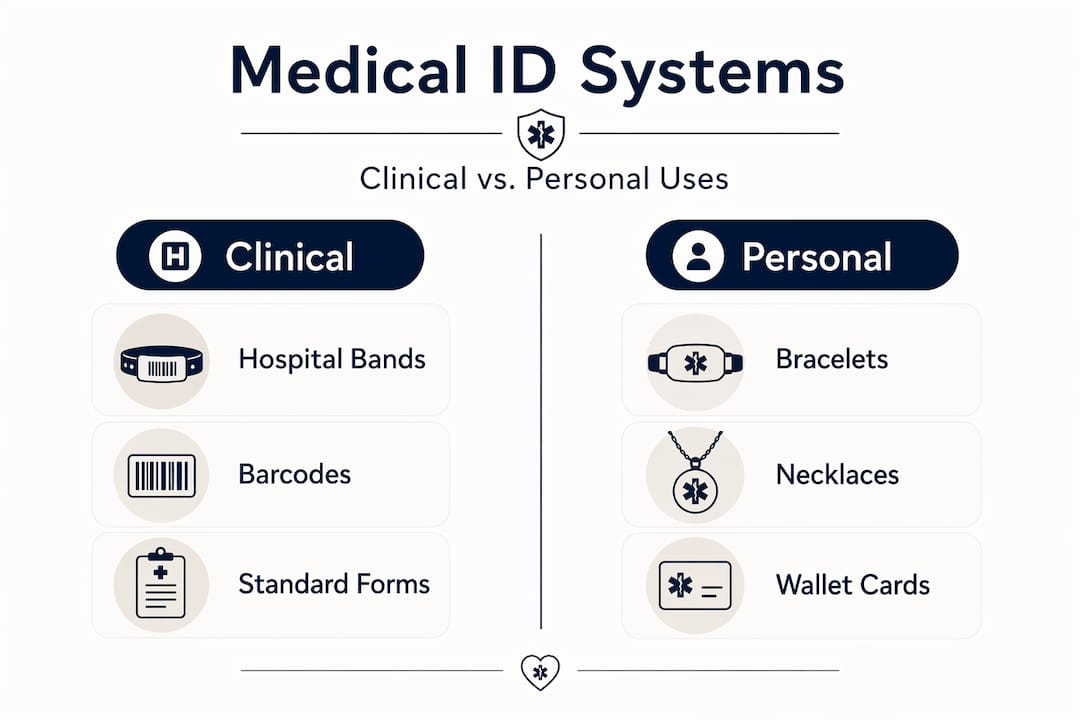
| Type | Best For | Strengths | Limitations |
|---|---|---|---|
| Hospital identity band | Inpatients, surgery patients | Standardized, scannable, tamper-evident | Single use, not for daily wear |
| Engraved bracelet/necklace | Chronic conditions, allergies | Durable, always visible, no tech needed | Limited information space |
| QR code medical ID | Tech-comfortable adults | Stores extensive health records | Requires phone scan, battery, signal |
| Wallet medical ID card | Backup identification | Easy to update, carries more detail | Not visible on an unconscious patient |
| Local program bracelet | At-risk individuals, seniors | Links to case records and safety networks | Program availability varies by location |
Each type serves a different context. For a child with a peanut allergy at school or a weekend soccer game, an engraved bracelet wins every time. It requires no technology, no unlocking, and no signal. A responder can read it in under five seconds. For an adult managing complex conditions and comfortable with technology, a QR code ID can supplement an engraved piece with deeper medical history.
The medical identification system benefits are compounded when you layer these types. An engraved bracelet for immediate visibility plus a wallet card with full medication lists gives responders two chances to get it right.
Choosing the right material matters too
The physical material of a personal medical ID affects both safety and wearability. Stainless steel, titanium, and silicone are the most common choices. Each has trade-offs. Stainless steel is durable and affordable. Titanium is lightweight and hypoallergenic, making it ideal for people with metal sensitivities. Silicone is flexible and water-resistant, a good option for active children or athletes. You can explore safe metal selection in more depth if material choice is a concern for you.
How to implement personal medical ID standards effectively
Getting a medical ID is the first step. Making sure it actually works in an emergency is the full goal. Here are the best practices for medical IDs that make a measurable difference:
-
Engrave the most critical information first. Space on a bracelet is limited. Lead with the condition or allergy that poses the greatest immediate risk. A responder who reads only the first line needs to get the most important fact from that line.
-
Choose durable, readable engraving. Deep laser engraving on metal outlasts surface printing by years. Avoid fonts that are decorative at the cost of legibility. Clean, sans-serif lettering reads fastest under stress.
-
Review and update the ID annually. Conditions change. Medications change. Emergency contacts change. A medical ID with an outdated phone number or discontinued medication is less reliable than one kept current. Put a reminder in your calendar every year.
-
Make it a daily habit, not an occasional accessory. Medical IDs only work when worn. For children especially, establishing the routine early makes wearing it feel normal rather than burdensome.
-
Consider a backup. Pair a bracelet with a wallet card or a phone-based health profile. Many smartphones allow you to store emergency medical information accessible from the lock screen, which can supplement a physical ID without replacing it.
-
Register with local programs if available. Programs like the SFPD’s bracelet initiative connect your ID to a broader safety network. If a similar program exists in your area, it adds a layer of support beyond what any piece of jewelry can carry alone.
For seniors managing multiple conditions, the stakes are particularly high. An emergency contact on jewelry is one of the most reliable ways to make sure responders can reach family quickly.
My take on why most people get this wrong
I’ve seen a lot of conversations about medical IDs where people focus almost entirely on what to engrave and almost nothing on how a responder will actually interact with that ID under pressure. That’s a real gap in the practical guidance out there.
In my experience, the biggest failure mode for personal medical IDs isn’t a bad standard. It’s an ID that exists but fails at the moment of use. The engraving is too small. The bracelet is worn on the dominant hand and hidden under a jacket. The QR code requires an app that the paramedic doesn’t have installed. None of those problems require a new regulation. They require the person wearing the ID to think like a responder for a few minutes.
I believe the importance of medical identification isn’t just about having something on your wrist. It’s about having something that communicates clearly, instantly, and without conditions. Physical, engraved IDs remain the gold standard for exactly this reason. They work without power, without signal, without unlocking anything. When I think about what actually saves lives in the first minutes of an emergency, that simplicity is hard to beat.
One more thing worth saying: caregivers and parents often think about medical IDs for the person they care for, but not for themselves. If a caregiver is also incapacitated in the same emergency, responders need to know who that child or patient’s information network is. Wear your own ID.
— Mack
Find the right medical ID for your needs
If reading this has made you think about upgrading or getting a first medical ID, you’re in the right place. Divotiusa offers a full range of medical alert bracelets and necklaces designed to meet the practical standards that actually matter in emergencies: clear engraving, durable materials, and styles you’ll actually want to wear every day.
Every piece can be customized with your specific conditions, allergies, and emergency contacts. Divotiusa’s selection includes options in stainless steel, titanium, and hypoallergenic silicone, so you can match comfort and safety to your lifestyle. Whether you’re choosing for yourself, a child with allergies, or an aging parent, you’ll find options that are built to be worn and read under pressure. Explore the full selection and find the piece that fits your life and keeps your information exactly where it needs to be.
You can also browse the bracelet style guide for help choosing a design that balances function and personal style.
FAQ
What does medical identification standard mean?
The term refers to two separate systems: formal clinical protocols used by hospitals to identify patients (such as NHS identity band standards and HIPAA de-identification rules), and the established best practices individuals follow when wearing personal medical alert jewelry or carrying medical ID cards.
Who needs to wear a medical ID?
Anyone managing a chronic condition, severe allergy, or medication that could affect emergency treatment should wear a medical ID. This includes people with diabetes, epilepsy, heart conditions, and severe food or drug allergies, as well as individuals with dementia or cognitive impairments.
What information should be on a personal medical ID?
Standard best practices recommend including your full name, primary medical condition or allergy, critical medications to avoid, and at least one emergency contact number. Keep the wording brief and prioritize the condition that poses the greatest immediate risk.
Are QR code medical IDs a reliable standard?
QR code IDs can store extensive health records, but they require a working smartphone, signal, and in some cases a specific app. Physical engraved IDs remain the more reliable choice for emergency use because they are readable without any technology.
Is there a legal requirement to wear a medical ID?
No federal or state law in the United States requires individuals to wear a medical ID. However, well-established medical alert standards and programs strongly recommend them for anyone whose condition could affect emergency treatment decisions.
Recommended
- How to Select Medical Alert Metal Type Safely - Divoti Inc.
- Engraved Medical Bracelet Styles That Work for You - Divoti Inc.
- Why Seniors Need Emergency Contact Jewelry - Divoti Inc.
- Medical Alert Bracelets, Cuff and Necklaces, Pet IDs, Car Gear
Shop related Divoti medical IDs: browse our custom engraved medical alert bracelets with free custom engraving. Most styles are HSA/FSA eligible.
About the author: Mack Johnson is Senior Operations Manager at Divoti Inc. in San Marcos, California, where he has led operations, marketing and customer experience since 2013. Before Divoti, he spent 12 years as a Public Health Services District Director with the Vermont Department of Health, leading regional public health operations and community health planning. He holds a bachelor’s degree from the University of Vermont. Connect with Mack on LinkedIn.