
Dementia Medical ID Bracelet: How to Choose One Your Loved One Will Keep On
Posted by Mack Johnson on Oct 13th 2026
Why a Dementia Medical ID Bracelet Matters
If someone you love is living with Alzheimer's or another form of dementia, you've probably had the thought: what if they walk out the door and can't tell anyone who they are? It's one of the most common fears caregivers share, and for good reason.
According to the Alzheimer's Association, 6 in 10 people living with dementia will wander at least once, and many do so repeatedly. Wandering can happen at any stage of the disease, even with the most careful caregiver in the house.
The good news is that most people who wander are found close to home, often within about 1.5 miles. What makes the difference is how quickly a neighbor, store clerk, or police officer can figure out who your loved one is and who to call. That's exactly the job of a dementia medical ID bracelet.
In this guide, we'll cover why ordinary bracelets often fail people with dementia, what features actually matter, what to engrave, and practical tips to help your loved one keep their ID on every day.
Why Ordinary Bracelets Often Fail People with Dementia
A standard medical alert bracelet works well for someone who understands why they're wearing it. Dementia changes that. Here's where regular bracelets tend to fall short:
- They're easy to take off. A simple lobster or toggle clasp can be opened in seconds. A person who feels restless or doesn't recognize the bracelet may remove it and leave it behind.
- They feel unfamiliar. As memory changes, a new object on the wrist can feel strange or even upsetting, which leads to fidgeting and pulling.
- They get lost in the wash or the nightstand. Bracelets that need to come off for bathing or sleep often don't make it back on.
- The engraving is too vague. "Memory loss" alone doesn't tell a stranger what to do or who to call.
A bracelet only helps if it's on the wrist at the moment it's needed. That's why the clasp matters more for dementia than for almost any other condition.
What to Look For in an Alzheimer's or Dementia Bracelet
1. A safety clasp that resists removal
This is the single most important feature. Look for a clasp designed to stay closed unless a caregiver opens it deliberately. Divoti's Alzheimer's / Dementia Medical ID Bracelet with Safety Clasp uses a secure clasp built to prevent accidental removal, which is why it's a go-to choice for families worried about wandering.
2. A comfortable, familiar feel
If the bracelet pinches, catches on sleeves, or feels heavy, your loved one will notice it all day. Choose a smooth link chain in a size that fits snugly without being tight. Divoti's dementia bracelet comes in four sizes, from extra small (5.5 to 6 inches) to large (8 to 9 inches). Check our size guide before ordering.
3. Waterproof stainless steel
Stainless steel can be worn in the shower and to bed, so it never has to come off. That removes the most common moment when an ID gets lost.
4. Enough room to engrave what matters
A bracelet with only two or three lines forces you to leave out key details. Divoti's dementia bracelet offers 8 lines of engraving: 4 on the front and 4 on the back.
5. A style they'll accept
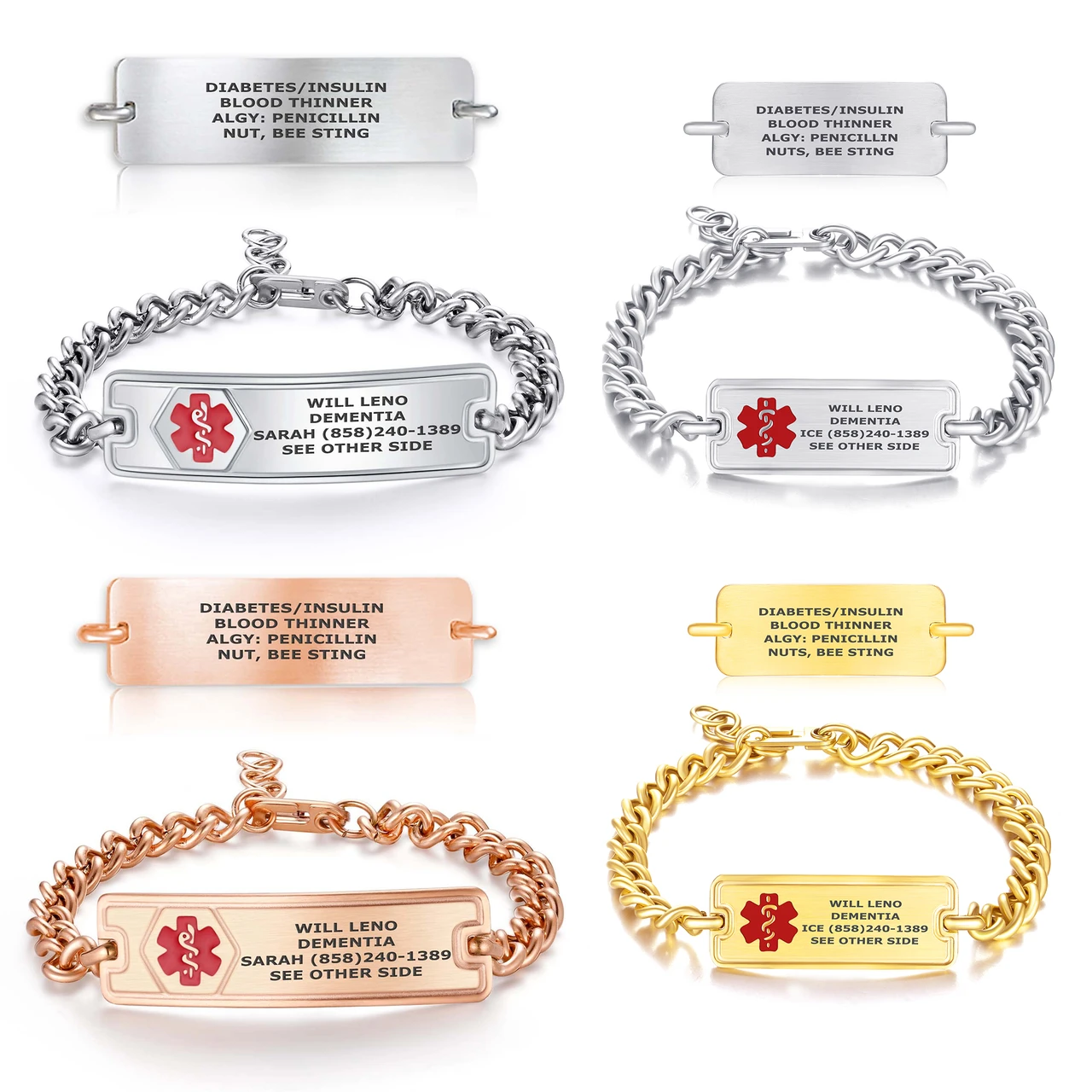
Many people with dementia still care deeply about how they look. A bracelet that looks like jewelry rather than a hospital band is far more likely to stay on. Finishes like polished stainless, gold, rose gold, and black let you match your loved one's taste.
6. Engraving first, tech second
Engraved information can be read instantly by anyone, with no phone, signal, or app required. If you add a digital profile, treat it as a backup to the engraving, never a replacement. We explain why in Why QR Code Medical IDs Are a Dangerous Placebo.
What to Engrave on a Dementia Medical ID Bracelet
The goal is simple: a stranger should be able to read the bracelet and know, within seconds, that this person needs help getting home and who to call. Put the diagnosis and the request for help on the front, and contacts and medical details on the back.
Here's a sample layout that fits Divoti's 8-line dementia bracelet (up to 18 characters per front line, 20 per back line):
| Side | Line | Example |
|---|---|---|
| Front | 1 | MARY SMITH |
| Front | 2 | ALZHEIMER'S |
| Front | 3 | MEMORY IMPAIRED |
| Front | 4 | MAY BE LOST-CALL |
| Back | 1 | DAUGHTER ANN |
| Back | 2 | 555-123-4567 |
| Back | 3 | SON TOM 555-987-6543 |
| Back | 4 | DIABETIC. ON INSULIN |
A few tips:
- Use a first and last name, so first responders can address your loved one calmly and look them up.
- List two contacts in case one doesn't answer.
- Add the most critical medical detail if space allows, such as diabetes, a blood thinner, or a severe allergy.
- Skip the home address on the bracelet. A phone number gets your loved one home just as fast without exposing where they live.
For more ideas, see What to Engrave on a Medical ID Bracelet or Necklace. Engraving is always free at Divoti.
6 Tips to Help Your Loved One Keep Their ID On
Even the best clasp works better when the bracelet feels like a natural part of the day. Caregivers tell us these approaches help:
- Introduce it as a gift. Present the bracelet as jewelry from a grandchild or spouse rather than a medical device. A personal connection makes it feel worth keeping.
- Put it on during a calm moment. Avoid fitting it during a stressful time of day or right before an appointment.
- Match their style. Someone who always wore a gold watch may happily accept a gold-tone bracelet. Familiar looks reduce fidgeting.
- Get the fit right. Too loose and it slides over the hand; too tight and it irritates. Aim for about one finger's width of space.
- Leave it on 24/7. Stainless steel handles showers and sleep. Every time it comes off is a chance for it to go missing.
- Add other layers of protection. An ID bracelet works best alongside door alarms, a recent photo on file, and a plan for what to do if your loved one goes missing. The Alzheimer's Association recommends calling 911 if a person with dementia isn't found within 15 minutes.
Frequently Asked Questions
What is the best bracelet for someone with dementia?
The best dementia bracelet has a safety clasp that's hard to open by accident, is made of waterproof stainless steel so it can stay on 24/7, and has enough engraving space for a name, diagnosis, and two emergency contacts.
Can a person with dementia take off a medical ID bracelet?
With a standard clasp, yes, often easily. A safety clasp is designed to resist removal, which makes it far more likely the bracelet will still be on if your loved one wanders.
Is a bracelet or necklace better for dementia?
For most people with dementia, a bracelet is better. It's more visible to first responders, and a well-fitted bracelet with a safety clasp is harder to remove than a necklace that can be slipped over the head.
Should I engrave my loved one's home address?
We recommend phone numbers instead. Contacts get your loved one home just as quickly without putting your address on display.
Can I use my HSA or FSA to buy a dementia medical ID?
Yes. Divoti's Alzheimer's / Dementia Medical ID Bracelet is HSA/FSA eligible. Learn more about using your HSA/FSA card at Divoti.
Give Your Family Peace of Mind
You can't be beside your loved one every minute, but their ID can be. A dementia medical ID bracelet with a safety clasp means that if they ever do wander, the person who finds them will know who they are and exactly who to call.
Divoti's Alzheimer's / Dementia Medical ID Bracelet with Safety Clasp includes free custom engraving, ships within 1 to 2 business days, and is HSA/FSA eligible. Browse more options in our senior medical alert bracelets and necklaces collection.
For caregiving support, the Alzheimer's Association's free 24/7 Helpline is available at 1-800-272-3900.
Related reading:
- What Is a Senior Medical Alert ID: A Safety Guide
- Top 3 Emergency ID Bracelets Comparison for Seniors 2026
- Who Needs to Wear a Medical ID?
Sources: NCOA, Understanding Wandering Risks (citing Alzheimer's Association data).